Pseudo Format for an instruction:
add $t0, $t1, $t2
add rd, rs, rt

lw $t0, 4($s1)
lw rt, imm(rs) ; imm stands for immediate
What part of your body gives you intructions?
Your brain.
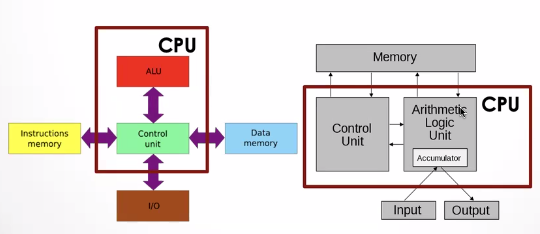
Key Components of a Computer
Input (Keyboard, Mouse)
Output (Monitor, Printer)
Memory(Primary, Split)
Datapath
Control Unit
Datapath + Control Unit = Processor
Classes of Computers
| Class | Description |
|---|---|
| Personal | General purpose, variety of software |
| Server | Network based, high capacity, reliable, ranges from small servers to building sized |
| Supercomputer | Type of server, scientific/engineering calculations, highest capability |
| Embedded | Hidden as components, stringent power/performance/cost constraints |
| Mobile devices | Smartphones, tablets, rely on battery |
Understanding Performance
| What it determines | |
|---|---|
| Algorithm | Number of operations executed |
| Programming language | Number of machine instructions per operation |
| Processor & Memory System | How fast instructions are executed |
| I/O System | How fast I/O operations are executed |
Eight Great Ideas
- Design for Moore’s Law
- Use abstraction to simplify design
- Make the common case fast
- Performance via parallelism
- Performance via pipelining
- Performance via prediction
- Hierarchy of memories
- Dependability via redundancy
Tip: Make the common case fast.
Thus, MIPS has 32 general purpose registers.
Consider the following code:
| CISC | RISC |
|---|---|
mov $t0, 0 | add $t0, $0, $0 |
Both codes do the same thing (storing 0 in $t0), but RISC tries to reuse existing instructions.
Another example:
add $t0, $t1, $t2 ; requires 2 lw instructions
addi $t0, %t1, 69 ; requires 1 lw instruction
To be continued...